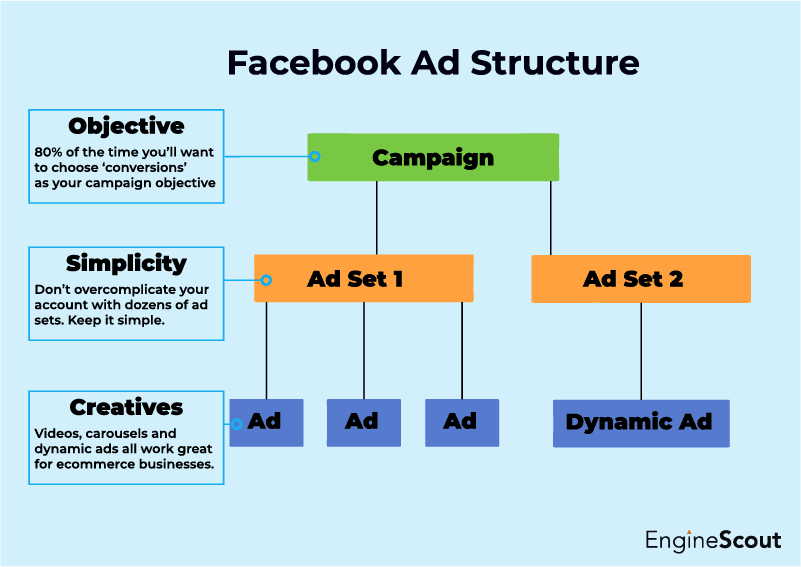
Facebook Ads in 2025 are a completely different game than they were just a few years ago. Back then, advertisers had to run countless campaigns, test dozens of audience types, and constantly tweak every setting inside Ads Manager. Success often meant juggling multiple ad sets, obsessively narrowing down interests, and relying on manual optimizations.
Today, that approach is outdated. The winning formula now centers around simplified, consolidated campaign structures with creative strategy at the core rather than constant micro-management. With Meta’s algorithm becoming more powerful and intuitive, advertisers are now rewarded for cleaner setups and high-quality creative inputs.
Let’s get one thing straight. There’s no single structure that works for every business. Every brand is different. Some sell high-ticket items, others run on subscriptions, and budgets vary across the board. However, there is a foundational framework that works as a flexible blueprint. You can tailor it based on key factors like your business type, product nature, and ad spend.
After managing campaigns across various verticals, ad budgets, and product types, here’s how I typically break it down.
Goal: Minimize risk while identifying early winners
Small businesses usually operate with limited budgets, which means there’s little room for waste. In this case, CBO (Campaign Budget Optimization) is your best friend. Instead of running multiple ad sets and spreading the budget thin, we let Meta’s algorithm decide which creative deserves the spend.
While traditional advice says to test creatives in ABO (Ad Set Budget Optimization), that can be too risky for small accounts. ABO divides the budget evenly across ad sets, regardless of performance. On the other hand, CBO automatically shifts budget to the best-performing creatives, helping small brands conserve budget while still identifying potential winners.
This method reduces risk, accelerates feedback, and helps brands quickly determine whether an ad concept is worth scaling or needs to be scrapped.
Once you’ve found one or two winning creatives based on ROAS, engagement, or consistent purchases, you’re ready to scale.
Keep testing! Even with winners, creative fatigue is real.
Goal: Fairly test creative angles and formats
With a larger budget, businesses can afford to take more calculated risks. That’s where ABO becomes more effective. You can assign equal budget to each creative and monitor performance without the risk of early budget shifts that CBO sometimes causes.
ABO allows for true split testing, where each creative gets a fair shot without being overpowered by early engagement spikes. This helps you collect cleaner data and understand which format, angle, or message resonates most.

You can objectively compare creatives and confidently identify what outperforms the rest. This makes scaling more strategic and less guesswork-driven.
After identifying winners, move them into a Scale Campaign (CBO) and continue using ABO for ongoing creative testing.
Goal: Leverage volume and performance data at scale
When you’re operating at scale, your testing strategy shifts from fairness to volume and speed. The goal isn’t to give each creative an equal budget but to test as many ideas as quickly and efficiently as possible.
At this level, each creative should be isolated in its own ad set. This avoids overlap and allows for better budget distribution as the algorithm identifies winners.
If your pixel has sufficient historical data, consider setting up a Cost Cap Campaign. These campaigns only spend when your ideal CPA is likely to be met, which can dramatically improve efficiency for mature ad accounts.
This structure balances aggressive testing with performance control. It plays to the strengths of larger budgets and more robust data, allowing you to scale faster without sacrificing profitability.
Not all businesses fit neatly into one of the three structures above. Some brands require unique approaches based on their product offering or target geography.
A messy campaign structure often does more harm than good. If your account is packed with overlapping campaigns and redundant ad sets, you’ll end up:
Meta’s advertising system is smarter than ever. Instead of trying to outsmart the algorithm, the best approach is to work with it. This means:
Pro Tip: Spend less time micromanaging campaigns and more time building great creatives.
Drop your thoughts in the comments or reach out directly at hello@digitorm.com. We’d love to help you build a campaign structure that performs.
Discover why mobile marketing should be your top priority in 2025. Learn about the latest trends, from in-app ads to 5G, and how Digitorm can help you stay ahead!








.jpeg)
